
Are we there yet? How Prof Craig Ritchie wants to redraw the brain health agenda road map
2 February, 2026 4 min read
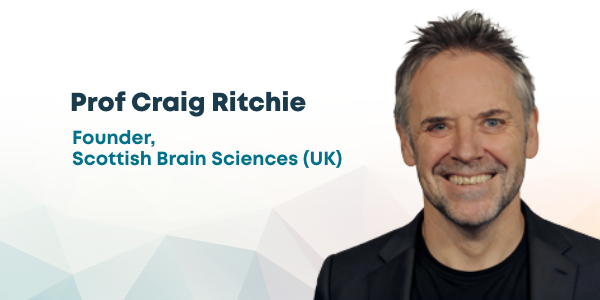
When you've been on a journey, you're in a much better position to determine the best direction - and it's time to reroute, says Prof Craig Ritchie.
Professor Craig Ritchie has been one of the loudest voices driving the global brain health agenda for nearly two decades.
He is the Professor of Brain Health and Neurodegenerative Medicine at the University of St Andrews, was previously Honorary Chair of Psychiatry of Ageing and Director of the Centre for Dementia Prevention University of Edinburgh, and has worked extensively across both research and clinical settings.
But in 2022, frustrated with the sector’s slow uptake of new ideas, Craig felt compelled to take a new road, founding a neuroscience research company called Scottish Brain Sciences that develops early diagnostic tools and treatments for people with brain conditions. It’s part of an attempt to toss out the old brain health agenda road map and come up with a new one.
‘In the past,’ said Craig, ‘we assumed that, if you made a compelling argument and you shouted long enough and often enough about it, the system would change.’
But persuading leaders – in the government, the sector, the community – to get on board is one thing. It turns out that action on the ground requires more time, and perhaps the pulling of different levers.
It’s been years since the launch of the whole brain health agenda...but on the ground the clinical care for patients hasn't changed one bit.
‘It’s been years since the launch of the whole brain health agenda, which is now gathering huge momentum, but on the ground the clinical care for patients hasn't changed one bit,’ he pointed out.
‘There's a big disconnect between what people recognise in manifestos and political discourse as being the right thing to do. But when you look at clinical care in the US, the UK, Australia, it hasn't moved much from where it was 30 years ago. It is still very much focussed on dementia rather than prevention.’
The problem isn’t with winning hearts and minds, Craig insists. Both the general public and political decision makers are motivated to act – it’s the gigantic, slow, risk-averse healthcare systems that take a long time to turn around.
The problem isn’t with winning hearts and minds...it’s the gigantic, slow, risk-averse healthcare systems that take a long time to turn around.
Which is where nimble, entrepreneurial organisations like his own come in. If there are five categories of innovation adoption (innovators, early adopters, early majority, late majority and laggards), those systems are the laggards, while innovation centres like Scottish Brain Sciences are the ones developing the new ideas and partnering with early adopters to pilot them.
‘As an innovator, you can only influence the group adjacent to you, so incubator or innovation sites shouldn't be trying to change the laggards and even the late adopters,’ Craig said. ‘What they need to do is connect with the early adopters, who have a higher risk appetite and more resources. The trick is to find them.’
It’s also time, he believes, to move brain health out of the hospitals and specialist clinics and into the pharmacies and optometrists and physiotherapists – the places people visit when they’re still well and prevention or early detection will have the most impact. Advancements in digital technology should also be embraced to spread the latest information.
Despite the altered route he supports, Craig doesn’t think the trajectory of the last 20 or so years has left us way off course.
‘When you’ve been on a journey, you’re in a much better position to draw the road map than you were at the start,’ he said. ‘We've learned a lot, and now we have a better idea of what we should do moving forward.’
The whole person.
The whole point.
He’s a husband and a father.
Loves a good run (you might catch him doing a lap along Sydney Harbour during IDC).
Played rugby in the past but now runs brain health clinics for former players.
Enjoys travelling to exotic locations.
Explore the full program
Find out who will be joining Craig on the plenary stage at #IDC2026 and register today